
Active governance through
artificial reasoning.
Arcus builds AI that can defend its decisions. Artificial reasoning is reasoning engineered as computation — the trace is the computation, not a story the model tells afterward — so every step is inspectable and every action auditable. Built on right-sized open models that run on hardware you own.
Regulated industries can’t deploy AI they can’t defend.
Most AI governance platforms record the reasoning the model reports about itself — inventory it, validate it, file it. That is passive governance — however well-organized, the record still reflects the model’s own account of its reasoning. Regulators ask something else entirely — how the decision was reasoned, where it was challenged and caught, and why the institution stands behind it. Active governance answers from within the decision: the trace is the computation, not a report about it.


The infrastructure of artificial reasoning.
The Arcus Protocols shape how an AI reasons through a decision. Each decision is structured, each output is scored, and the reasoning architecture can be shaped by domain experts without engineering support. Auditability is not a feature added on top. It is how the system is built.
Iterative Reasoning Graphs
IRG breaks AI decisions into typed, traceable steps: generation, retrieval, verification, evaluation, and synthesis. The system works through them iteratively until a defined standard is met. Drafts are discarded. The reasoning behind them is not.
Epistemic Integrity Engine
EIE scores every reasoning output across four dimensions: factual accuracy, logical coherence, source fidelity, and claim support. The result is a continuous integrity metric built for regulators, auditors, and insurers to reference. Not a binary pass or fail. A continuous read on the quality of the reasoning itself, designed to be validated like any model output.
Graph Definition Language
Reason gives teams a way to define how their AI thinks. Seven composable operations have expressed every reasoning structure we’ve needed so far — a domain role like Adversary or Fact-Check is an operation plus a prompt set, not new machinery. Domain experts can configure and adjust reasoning structures on their own, without engineering support or knowledge of graph theory.


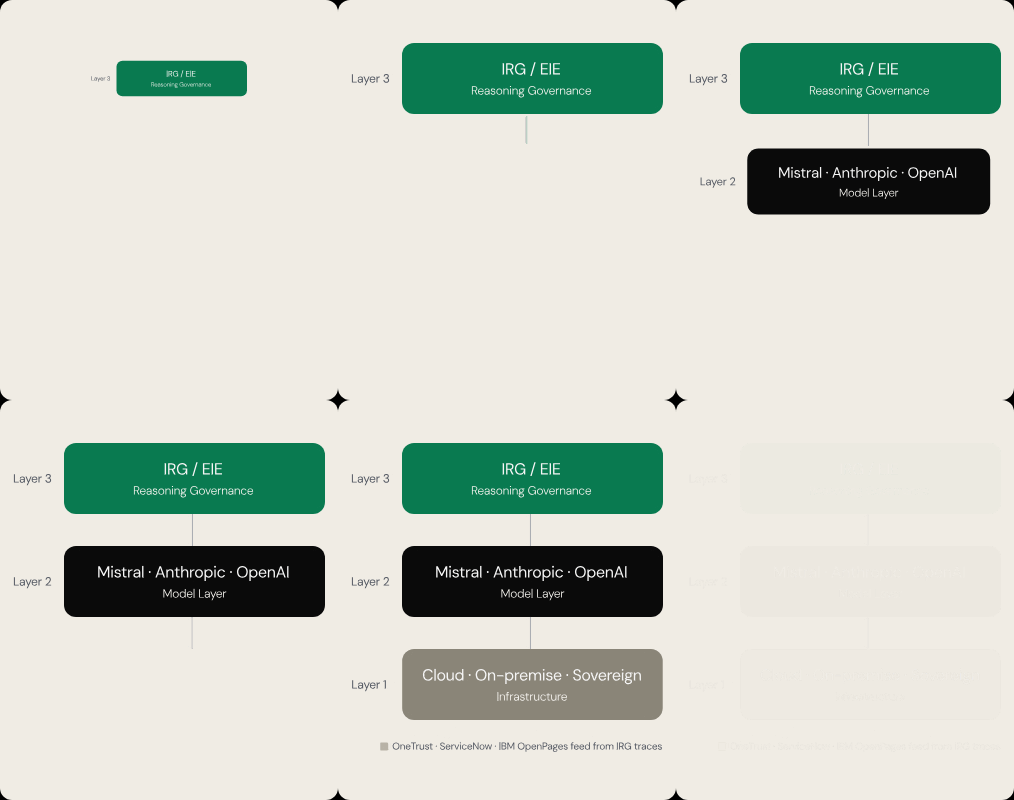
Above the model layer. Beside the GRC platform.
IRG does not replace your governance platform or your model provider. It connects them. Model calls are orchestrated within a structured reasoning process, and every step produces the traces and scores that turn compliance documentation into something auditors can actually use.

One engine, a sequence of regulated markets.
We prove the engine with a real result in one regulated domain, then point the same governance gate at the next. Each new vertical is a new ruleset — not a new build.
Reg E dispute adjudication
Complete fraud-dispute determinations with cited evidence, drafted end-to-end in about a minute on an open-weight model — every step auditable, with a human attestation surface built into the record. This is the beachhead, live today.
Coverage governance
The gate that checks Reg E rules checks a carrier’s coverage clauses — sold to the party carrying the liability, before a claim materializes.
Model Risk Management
Validate model packages against SR 26-2, the Fed/OCC model-risk guidance rewritten for AI in 2026 — from the same engine that earns credibility in adjudication.
One protocol. Many compliance surfaces.
Most frameworks converge on the same evidentiary core: risk documentation, reasoning transparency, audit trails, quality management. IRG is built to produce that core from one underlying trace. The regulatory templates and prompt sets change by jurisdiction. The protocol does not.
EU AI Act: Articles 9–15
High-risk AI systems require technical documentation, automatic event recording, risk management, and human oversight. Credit scoring, employment, healthcare, insurance.
SR 26-2: Model Risk Management
The Fed/OCC model-risk guidance rewritten for AI in 2026, superseding SR 11-7. Validation evidence, effective challenge, and ongoing monitoring — Arcus produces all three from the same trace, under either standard.
Colorado AI Framework
Colorado repealed its 2024 AI Act before it took effect and re-enacted a narrower framework: disclosure, transparency, and documentation duties for automated decision-making in consequential decisions — employment, lending, insurance, housing.
Cross-jurisdictional
Institutions operating across borders tend to build to the strictest applicable standard. Because IRG emits one underlying trace, the same deployment can feed evidence into each framework’s template — the mapping changes, the trace does not.
Auditable. Efficient. Sovereign.
You can’t fully audit a model you don’t control. Efficiency is what makes ownership affordable, and commodity hardware is what makes it sovereign — the same bet, three faces. While inference is sold below cost, no one has to ask which decisions deserve it, or who owns the answer. The subsidy will end. We build for the market on the other side of it.
Auditable
Every inference inspectable, every action auditable — the reasoning trace produced as the decision is made, not reconstructed after. The kind of record regulators, auditors, and courts increasingly ask for.
Efficient
Right-sized open models, not frontier overkill. Optional while inference is subsidized — decisive after it.
Sovereign
Runs on premises, on high-end commodity hardware. No hyperscale rent, no remote off-switch, no cluster required. Air-gapped where it has to be.
“Scaling models improves the constants. Graph design can shift the Pareto frontier. The former is expensive and subject to diminishing returns. The latter is a design choice with compounding returns as the discipline matures.”— Reasoning Circuit Complexity, Arcus Reasoning Library
The thinking behind it.
The product stands on its own — but if you want the theory underneath, it is here. The formal framework for cognitive engineering and a growing library of reasoning strategies ported to executable IRG graphs: the R/K/G model, circuit complexity, and the graph shapes that run in production.
Reasoning Library
A working manual for cognitive engineering: the theory in plain terms, and a growing library of reasoning strategies ported to executable IRG graphs — each shown as the shape it actually runs as.
Explore the library →See what the examiner sees.
Talk is cheap; a dossier is not. Every IRG determination ships as a Regulator Dossier — an examiner-ready record of a single AI decision, generated with the decision itself. We produced one for a live Reg E overdraft-fee dispute — enter your work email and we’ll send you the full 21-page sample.
Examiner Artifact TOC
- Provenance — model, prompts, graph, and rule corpus pinned by SHA-256; re-hash and verify byte-equality
- Integrity seal — every model call sealed in a hash-linked chain; tampering is detectable from genesis
- Reasoning trace — the determination as a formal, step-by-step proof, plus every node’s actual output
- Citation provenance — each claim resolved to a verified regulation or evidence artifact
- Compliance timeline — the §1005.11 statutory clock, milestone by milestone
- Standards mapping — NIST AI RMF and model-risk guidance, evidenced line by line
- Known limitations & attestation — what the dossier does not prove, and the reviewer’s signature surface
Get the sample dossier
Almost there — check your inbox
Confirm your email and we’ll send the sample dossier right over.
Prefer to talk it through?
We are onboarding design partners in insurance coverage governance and model risk management now. Pick a time that works — no back-and-forth.
Book a Call